
Texas Pipeline Explosion Attorneys
Table of Contents
- Undefeated Pipeline Explosion Lawyers With Billions Won
- Injured in a Pipeline Explosion? Here’s What To Do Immediately
- Billions Won: Our Texas Pipeline Explosion Lawyers Have Won the Largest Settlements and Verdicts in History
- How We Can Help After a Pipeline Explosion
- The U.S. Pipeline Network at a Glance
- Key Pipeline Systems in the United States
- Major U.S. Pipeline Operators
- Aging Pipeline Infrastructure: Minimal Standards, Maximum Risk
- Common Causes of Pipeline Explosions
- History of Deadly Pipeline Explosions
- Why Hire Zehl & Associates After a Pipeline Explosion?
- Undefeated Pipeline Explosion Attorneys: 1-888-603-3636 for a Free Consultation
- FAQs
- Helpful Resources
Undefeated Pipeline Explosion Lawyers With Billions Won
America runs on oil and gas pipelines, with more than 2.6 million miles of high-pressure infrastructure crisscrossing the country to power homes, fuel industries, and keep the economy moving. But nearly half of these lines are over 50 years old and pushed far beyond safe limits.
Millions of miles of corroded, aging pipelines are in disrepair — and energy companies are failing to keep up — putting workers, neighborhoods, and communities at the highest risk of catastrophic explosions the country has ever seen. In fact, 2023 and 2024 were the deadliest years for gas explosions in the past two decades, according to congressional testimony from watchdog group Pipeline Safety Trust.
When pipeline companies cut corners or ignore known hazards, Zehl & Associates steps in to stand up, fight, and win for explosion victims. Our undefeated trial attorneys have recovered Billions for injured workers and families, including historic recoveries for hundreds of workers injured in Williams, BP, ConocoPhillips, and Shell explosions. We know how to expose systemic safety failures, hold major energy companies fully accountable, and secure the resources our clients need to rebuild their lives.
Read on to learn more about pipeline explosions, why they continue to happen, and how our nationally recognized pipeline explosion lawyers can protect your rights and secure your future.
Injured in a Pipeline Explosion? Here’s What To Do Immediately
A pipeline explosion upends life in an instant and leaves victims unsure where to turn. But the truth is, what you do in the hours and days after an explosion — and who you choose to represent you — can mean the difference between securing your future and being left with far less than you deserve.
Because pipeline explosions often cause mass injuries, fatalities, and widespread property damage, these cases frequently involve very large recoveries — sometimes record-setting ones. Pipeline operators, their insurers, and their defense attorneys know this. And they will do everything possible to avoid accountability and pay you as little as possible.
If you were injured in a pipeline explosion, your first priority should always be your health. Call 911 and seek medical attention immediately—even if you don’t think you’re seriously hurt. Some of the most dangerous injuries, including internal trauma and burns, are not always immediately obvious. Preserve any clothing you were wearing and avoid discarding anything connected to the incident.
To protect your legal rights, it’s critical to take the following steps:
- Do NOT trust the pipeline company to “take care of you.” No matter how sympathetic they sound, pipeline operators and their insurers are focused on one thing: minimizing their financial exposure.
- NEVER speak with the company’s claims adjuster or investigators. Do not give a recorded statement or sign anything before speaking with a lawyer. A single misstep can cost you and your family millions.
- Contact an experienced pipeline explosion lawyer as soon as possible. You deserve a legal team with a track record of taking on the largest energy companies in the world and not just winning, but setting records. Contact us today at 1-888-603-3636.
Billions Won: Our Texas Pipeline Explosion Lawyers Have Won the Largest Settlements and Verdicts in History
Every attorney at Zehl & Associates is undefeated at trial. That record has led to verdicts and settlements that make history—including the #1 Individual Burn Injury Settlement in U.S. History — and has established Zehl & Associates as one of the nation’s leading firms for holding petrochemical, energy, and oil and gas giants accountable.
Our attorneys have secured record-breaking recoveries in some of the most significant pipeline and industrial explosion cases in recent history, including:
- Shell Deer Park Explosion (2023)
- ConocoPhilllips San Juan Basin Explosion
- BP Deepwater Horizon Explosion
- Williams Geismar Explosion
- Williams Gibson Explosion
We are also actively representing victims injured in the 2024 Sandman Hotel explosion in Fort Worth, Texas, and the 2025 Smitty’s Supply explosion in Roseland, Louisiana.
We handle pipeline explosion cases in Louisiana, Texas, and across the U.S. — taking on the largest energy companies wherever catastrophic failures occur.
How We Can Help After a Pipeline Explosion
At Zehl & Associates, we do more than file lawsuits. We understand the immense physical, financial, and emotional toll an explosion has on our clients and their families. That’s why, from day one, we work to secure your future, ensuring that you:
- See the nation’s top doctors, burn injury specialists, reconstructive plastic surgeons, and occupational therapists.
- Have your medical bills and reasonable living expenses covered while your case is pending.
- Recover the full compensation you deserve for all of your injuries, future care, lost income, and long-term impact on your family
- Never have to worry that the company who did this to you will get away with it
In our experience, pipeline operators and their attorneys will stop at nothing to avoid responsibility after a catastrophic explosion. We know their tactics—and we know how to defeat them.
If the pipeline company refuses to offer a settlement that fully compensates you and your family, our trial lawyers are ready. We prepare every case for trial from day one, and we’ve never lost in the courtroom.
The U.S. Pipeline Network at a Glance
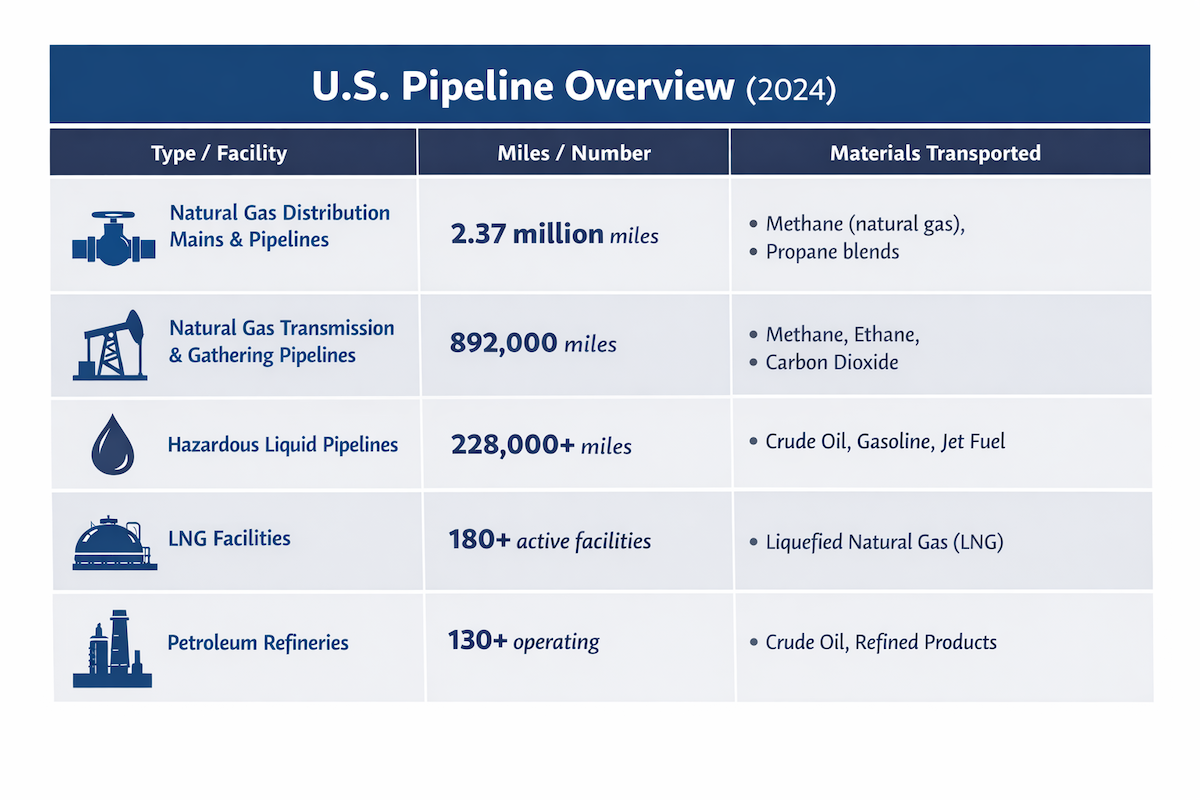
According to the Pipeline and Hazardous Materials Safety Administration (PHMSA), as of 2024 the United States has:
- 2.37 million miles of natural gas distribution mains and pipelines
- 892,000 miles of natural gas transmission and gathering pipelines, with capacity expanding rapidly in the Permian Basin, Haynesville, Eagle Ford, and Louisiana
- 228,000+ miles of hazardous liquid pipelines
- 180+ active liquefied natural gas (LNG) facilities connected to transmission and distribution systems, each handling enormous volumes of highly combustible fuel
- 130+ operating petroleum refineries nationwide, many directly connected to high-pressure pipeline systems
Across this growing network, pipelines routinely carry hazardous substances including crude oil, methane, gasoline, jet fuel, propane and butane, petrochemical feedstocks, and even carbon dioxide — all of which present serious explosion, fire, or toxicity risks, especially when transported through aging, poorly maintained pipelines never designed to operate at today’s capacity levels.
Key Pipeline Systems in the United States
The U.S. pipeline network moves enormous volumes of oil, gas, and hazardous materials beneath worksites, neighborhoods, and communities every day. These pipelines connect production fields to refineries, chemical plants, and export terminals and transport energy volumes that simply could not be moved safely or efficiently by truck or rail.
These pipeline systems fall into two primary categories.
1. Natural Gas Pipelines
Natural gas pipelines carry highly combustible methane used for heating, electricity, and industrial operations. This network includes:
- Gathering lines that move raw gas from onshore and offshore wells
- Transmission pipelines that carry gas long distances at high pressure
- Distribution pipelines that deliver gas directly to homes, businesses, and industrial facilities
Much of the system runs beneath populated areas, and many pipelines rely on decades-old and extremely dangerous steel and cast-iron pipe, which are highly prone to corrosion, cracking, and leaks — ruptures that could easily trigger a catastrophic leak or explosion. Natural gas pipelines supply roughly 25% of U.S. energy consumption, making any failure potentially catastrophic — nearly 73 million households and 5.6 million businesses use natural gas, according to the American Gas Association (AGA).
2. Oil and Hazardous Liquid Pipelines
These pipelines transport crude oil, refined fuels, and volatile liquids critical to the energy and chemical sectors. They often operate at high pressure near refineries, tank farms, and petrochemical plants, particularly in Texas, Louisiana, and the Gulf Coast. Failures can cause fires, explosions, toxic releases, environmental damage, and mass-casualty events.
Major U.S. Pipeline Operators
A relatively small group of companies controls vast portions of the nation’s pipeline network, and very few have a spotless record. These pipeline operators are required to comply with federal safety regulations, but most have documented violations, leaks, fires, or explosions. Yet, one recent investigative reports showed that most pipeline fires and explosions don’t even result in federal fines, leaving the burden of safety squarely on the companies themselves.
Energy companies make critical decisions every day, including:
- Whether to invest in full pipeline replacement or defer upgrades
- Whether to act on early warning signs or wait until a failure occurs
- Whether safety or short-term profits take priority
Atmos Energy
Operates one of the oldest natural gas distribution systems in the country, including hundreds of miles of steel and cast-iron pipe known to be highly susceptible to corrosion. Investigative reporting has linked Atmos pipelines to dozens of gas explosions in Texas, resulting in multiple fatalities, serious injuries, and repeated regulatory violations. Most recently, in 2024, concerns mounted over Atmos Energy’s network of pipelines once again after a mass casualty pipeline explosion at the Sandman Hotel in Fort Worth, Texas injured over two dozen workers and guests.
Kinder Morgan
One of the largest energy infrastructure companies in North America, operating over 80,000 miles of pipelines and transporting a significant share of the nation’s natural gas, crude oil, and refined products. In 2021, a pipeline owned by Kinder Morgan ruptured and exploded in Coolidge, Arizona, tragically killing two people and severely burning another.
Williams Companies
A major natural gas infrastructure operator focused on transmission, processing, and storage. Williams pipelines have been involved in multiple catastrophic explosion events, including the fatal explosion at Williams Olefins plant in Geismar, LA in 2013 and the deadly explosion at the Williams Partners plant in Gibson, LA in 2015, events that tragically killed five workers and injured hundreds more — cases in which Zehl & Associates secured landmark recoveries.
Energy Transfer
Energy Transfer operates tens of thousands of miles of pipeline across the United States, including the infamous Dakota Access Pipeline. The company has a history of pipeline violations and dangerous incidents. In 2022, a massive Energy Transfer pipeline explosion and fire prompted evacuations in Fort Bend County. And in 2024, a massive fire ignited when an Energy Transfer natural gas pipeline exploded in Deer Park, Texas, injuring four, damaging five homes, and cutting off power to thousands in the Houston area.
Enterprise Products Partners
A leading midstream operator with expansive networks transporting natural gas, natural gas liquids (NGLs), crude oil, and petrochemicals across Texas, Louisiana, and the Gulf Coast. In 2020, an Enterprise gas pipeline explosion killed four maritime workers aboard a dredge vessel in the Port of Corpus Christi and another pipeline explosion injured four, including one critically burned, the very same year in Martin County, Texas.
Chevron Pipeline Company
Manages crude oil, refined products, and CO₂ pipelines supporting Chevron’s upstream and refining operations. In Texas, Chevron pipeline assets serve major oilfields, refineries, and industrial facilities, with failures posing serious risks to workers and nearby communities.In 2014, a Chevron offshore pipeline exploded 6 miles south of Timbalier Bay off the southeast coast of Louisiana, tragically killing one contractor and injuring two more.
ExxonMobil Pipeline Company
Operates extensive crude oil, refined products, and chemical pipeline networks throughout Texas, particularly along the Gulf Coast and major refining corridors. ExxonMobil pipelines connect refineries, chemical plants, and export terminals —w here incidents can escalate quickly into large-scale industrial disasters. For example, an explosion at the ExxonMobil Olefins Plant in Baytown, Texas in 2021 sent four workers to the hospital, including three who sustained second and third-degree burns and another who suffered a broken femur. Just three years prior at the very same facility, an Exxonmobil explosion sent 40 workers to the hospital.
Aging Pipeline Infrastructure: Minimal Standards, Maximum Risk
Much of the nation’s gas and hazardous liquid pipeline network was installed decades before modern safety standards, corrosion-resistant materials, advanced leak detection systems, or today’s population density.
Federal regulations and agencies like PHMSA oversee pipeline safety, but these rules often set only baseline standards—insufficient for aging infrastructure and high-risk conditions.
Despite rules calling for the removal or replacement of high-risk pipelines—such as cast iron, wrought iron, and bare steel—many of these outdated lines remain in service today.
These aging pipelines are especially vulnerable when:
- Metal corrodes over time
- Welds weaken or fracture
- Protective coatings deteriorate
- Pressure cycling accelerates fatigue on already compromised pipe
Without robust inspection, proactive maintenance, and full replacement programs, failure becomes a matter of when — not if.
The Dangers of Aging Pipeline Infrastructure
When aging pipelines fail, the consequences are sudden and often devastating, including gas leaks that accumulate unnoticed, violent explosions, and fast-moving fires that spread into surrounding communities. According to PHMSA data, pipeline incidents have killed at least 463 people and injured thousands more over the past two decades.:
These failures commonly result in severe burn injuries, traumatic brain injuries, blunt-force trauma from blast overpressure, and exposure to toxic hydrocarbons and chemical vapors—injuries that frequently require long-term medical care and can leave victims with lasting or even permanent consequences.
For workers, these failures often occur in high-risk environments such as oilfields, refineries, compressor stations, and pipeline rights-of-way, where the margin for error is already thin. For residents, aging pipelines frequently run beneath neighborhoods, schools, and businesses—turning ordinary daily life into a life-threatening situation when safety systems fail.
Pipeline explosion injuries often leave victims unable to work, burdened by overwhelming medical costs, and struggling to support their families.
That is why our undefeated explosion lawyers focus not only on holding pipeline operators fully accountable, but also on ensuring our clients have access to top medical specialists, coverage for medical and living expenses while their case is pending, and trusted financial guidance to protect their recovery and their future.
Common Causes of Pipeline Explosions
In our experience, pipeline explosions are almost always the direct result of preventable safety failures — failures that occur when energy companies prioritize production targets, cost-cutting, and shareholder returns ahead of human life.
Despite well-established federal safety standards and decades of known risk factors, pipeline workers and nearby communities continue to suffer devastating injuries and loss of life from explosions that never should have happened.
These catastrophes often follow ignored warnings, deferred maintenance, inadequate training, or flawed decision-making at the corporate level.
Common causes of gas leaks and pipeline explosions include:
- Aging Pipelines: Decades-old, corrosion-prone pipelines are often left in service long past their safe lifespan.
- Improper Installation: Faulty welding, missing valves, or installation errors can allow gas to escape and ignite.
- Defective Equipment: Flawed pipeline components can fail under pressure and trigger explosions.
- Inadequate Maintenance: Skipped inspections and deferred repairs routinely lead to preventable failures.
- Inadequate Training: Poorly trained workers increase the risk of errors and delayed emergency response.
- Failure to Respond: Delayed responses to leak reports can quickly escalate into deadly explosions.
- Failure to Add Odorant: Improper odorization can prevent leak detection until ignition occurs.
- Excavation Damage: Unmarked pipelines can be struck during digging, causing ruptures and explosions.
When even one of these failures goes unaddressed, the result can be a sudden release of volatile gas or hazardous liquids, followed by fire, explosion, and irreversible harm.
Holding pipeline companies accountable is the only way to break this cycle and prevent the next avoidable catastrophe.
History of Deadly Pipeline Explosions
According to industry data, the pipeline sector’s on-the-job fatality rate is more than four times higher than the rate for American workers overall, spiking to seven times the national average several times in recent years.
Texas and Louisiana — home to some of the nation’s densest pipeline networks — have experienced a disproportionate share of these deadly failures.
Across Texas, leaks along Atmos Energy lines have killed at least nine people since 2006, while recent Centerpoint pipeline explosions have left numerous workers and contractors seriously injured. In Louisiana, natural gas and petrochemical pipelines serving the Gulf Coast’s industrial corridor have seen similar catastrophic incidents.
Recent and notable pipeline explosions in the U.S. include:
Sandman Hotel Explosion – Fort Worth, Texas (2024)
In January 2024, a natural gas explosion tore through the basement of the Sandman Hotel, injuring more than two dozen people, sending shockwaves through downtown Fort Worth, and raising scrutiny about the safety of Atmos Energy’s pipeline distribution system. Zehl & Associates is proud to represent over 21 victims harmed in this mass-casualty explosion.
Whitney Oil & Gas Offshore Pipeline Explosion – Venice, Louisiana (2024)
In August 2024, an offshore natural gas pipeline operated by Whitney Oil & Gas exploded near South Pass off the Louisiana coast. A contractor was tragically killed in the blast; his remains were recovered the following morning after he was initially reported missing.
Atmos Energy Pipeline Explosion – Farmersville, Texas (2021)
An explosion at an Atmos Energy facility killed two contractors and injured two others. Investigators cited Atmos for failing to maintain written procedures for operations, maintenance, and emergency response, as well as for failing to replace known unsafe pipeline sections.
Enbridge Pipeline Explosion — Kentucky (2019)
A natural gas transmission line on the Texas Eastern Pipeline exploded in Lincoln County, Kentucky, killing a 58-year-old grandmother, seriously injuring five others, and leveling dozens of nearby homes and vehicles. The Texas Eastern system—built before World War II and stretching over 9,100 miles—has experienced at least 83 major incidents since 1985, including multiple fatal and life-altering explosions.
Atmos Energy Pipeline Explosion — Dallas, Texas (2018)
In February 2018, the rupture of a leaking Atmos pipeline triggered an explosion that destroyed a North Dallas home and tragically killed a 12-year-old girl as she was getting ready for school. The Texas Railroad Commission later found that Atmos Energy’s failure to detect pipeline leaks in the days, months, and even hours before the blast was responsible for the horrific incident.
Merrimack Valley Gas Explosions – Massachusetts (2018)
A series of gas explosions and fires injured dozens and displaced thousands after over-pressurization of aging distribution lines—an example of how failures in populated areas escalate rapidly.
Williams Pipeline Explosion – Gibson, Louisiana (2015)
A natural gas pipeline explosion at a Williams Partners facility killed three contractors and seriously injured two others. The blast occurred during routine operations, as the workers were conducting scheduled maintenance on the “slug catcher,” a device responsible for collecting large flows of oil and gas traveling through a pipeline. Our attorneys recovered record-setting settlements on behalf of one of the workers killed in the Williams Gibson explosion, as well as seven others who were injured.
Williams Olefins Explosion – Geismar, Louisiana (2013)
One of the deadliest petrochemical pipeline-related explosions in U.S. history, the Geismar blast killed two workers and injured more than 100 others—many severely. Investigators later determined that a damaged pipeline connected to a distillation tower had been leaking for months before the explosion, ultimately releasing propylene gas that ignited. Zehl & Associates represented more than 60 workers injured in the Williams Geismar explosion, securing record-setting recoveries despite the company’s efforts to limit compensation to workers’ compensation benefits alone.
Why Hire Zehl & Associates After a Pipeline Explosion?
The aftermath of an explosion leaves families facing overwhelming medical bills, lost income, and lasting trauma. At the same time, pipeline operators and energy companies move quickly to protect themselves, deploying legal teams whose sole purpose is to avoid accountability and pay victims as little as possible for their injuries and losses.
Unless these companies are forced to take responsibility and fully compensate the people they’ve harmed, profits will always come before safety.
At Zehl & Associates, we are nationally recognized for taking on the largest energy corporations in the world and not only winning — we set records for industrial workers and their families.
Why Injured Workers and Families Choose Zehl & Associates
- Billions recovered for industrial workers: We’ve successfully represented thousands of workers nationwide, recovering the largest verdicts and settlements in our opponents’ corporate histories.
- Undefeated at trial: Every attorney at our firm is a seasoned trial lawyer—and we have never lost a case in court.
- Deep expertise in state and federal pipeline regulations: We know exactly how pipeline operators and insurers try to avoid responsibility—and how to combat their tactics.
- Every case prepared for trial from day one: We never settle unless the offer fully compensates you for all of your injuries, future care, lost earnings, and long-term impact on your family.
- No upfront costs: You pay nothing unless we win.
- Clients are like family: We strive to go above and beyond every step of the way, handling the legal burden so you can focus on healing. It’s just one reason that so many clients say: “Zehl took care of everything.”
Undefeated Pipeline Explosion Attorneys: 1-888-603-3636 for a Free Consultation
Having won Billions for our clients, including record-setting verdicts and settlements on behalf of hundreds of people injured or tragically killed in pipeline explosions and other industrial accidents throughout Texas and the United States, our attorneys have the resources and experience to ensure that our clients receive full compensation for all of their injuries and losses.
If you or a loved one were injured or tragically killed in a pipeline explosion, call us for a free consultation at 1-888-603-3636 or send us a confidential email via our Contact Us form.
All consultations are free, and you won’t owe us anything unless we win your case.
FAQs
Yes. Pipelines regularly transport highly combustible gases and volatile liquids under extreme pressure. When corrosion, defective welds, equipment failure, or human error goes unaddressed, gas or fuel can escape and ignite—causing fires, explosions, or mass-casualty events. Aging infrastructure and deferred maintenance significantly increase this risk.
Texas and Louisiana are home to some of the densest pipeline networks in the United States, many of which have experienced leaks, ruptures, or explosions due to aging infrastructure, corrosion, equipment failure, or deferred maintenance. Major systems with documented incidents include:
Natural Gas Pipelines:
- Transco Pipeline
- Gulfstream Pipeline
- Texas Eastern Transmission (TETCo)
- Permian Highway Pipeline
- Houston-area and North Texas distribution networks
Oil and Hazardous Liquid Pipelines:
- Mainline System (Gulf Coast segments)
- Line 6B / Line 67
- ECHO Pipeline
- Permian Basin oil and NGL pipelines
- Baytown–Beaumont–Galveston pipeline corridor
These pipelines often run through industrial zones, oilfields, refineries, and populated areas. When failures occur, they can lead to catastrophic fires, explosions, or toxic releases, putting workers and nearby communities at serious risk.
Liability may extend far beyond a single company. Depending on the facts, responsible parties may include:
- Pipeline owners and operators
- Energy companies and parent corporations
- Maintenance or inspection contractors
- Engineering or construction firms
- Equipment or component manufacturers
An experienced explosion lawyer can identify all at-fault parties and pursue full accountability.
Pipeline explosion claims often involve substantial damages due to the severity of injuries and losses. Compensation may include:
- Medical expenses (past and future)
- Burn treatment, surgeries, and rehabilitation
- Lost wages and reduced earning capacity
- Pain and suffering
- Disfigurement or permanent disability
- Loss of consortium
- Wrongful death damages, including funeral costs and loss of financial support
In cases involving gross negligence or safety violations, additional damages may also be available. lawyer can identify all liable parties and pursue full accountability.
There is no true “average.” Pipeline explosion cases vary widely based on the severity of injuries, number of victims, available insurance, and corporate misconduct involved. That said, because these cases often involve catastrophic injuries and large corporate defendants, settlements and verdicts can reach millions—or even tens of millions—of dollars. Record-setting recoveries are not uncommon when companies are forced to fully account for their failures.
Some cases resolve within months, while others—especially those involving multiple victims or major energy companies—can take one to several years. The timeline depends on the complexity of the investigation, the number of defendants, and whether the case goes to trial. At Zehl & Associates, every case is prepared for trial from day one to avoid unnecessary delays and pressure companies to offer full compensation.
Time limits (statutes of limitation) vary by state and by the type of claim involved. In Texas and Louisiana, strict deadlines apply, and evidence can disappear quickly. Waiting too long can permanently bar your claim. Speaking with a pipeline explosion lawyer as soon as possible helps ensure critical evidence is preserved and deadlines are met.
Key evidence may include:
- Incident and investigation reports
- PHMSA and regulatory records
- Maintenance and inspection logs
- Pipeline design and construction documents
- Surveillance footage and photographs
- Witness statements
- Medical records and expert testimony
Pipeline companies often control much of this evidence, which is why immediate legal action is essential to preserve it.
Helpful Resources
FREE CASE REVIEW
Fill Out the Form Below for a Free Case Review with our Undefeated Personal Injury Lawyers
Practice Areas
Ask Ai About Our Firm


All communications are private and confidential. This site is protected by reCAPTCHA and the Google Privacy Policy and Terms of Service apply.