

Undefeated Texas Oilfield Accident Lawyers
Tank batteries are essential to oilfield production, but they also create significant safety risks on the well site. As any oilfield worker knows, especially pumpers and tank battery operators, these dangers are very real.
In an instant, the presence of flammable hydrocarbon vapors, improperly maintained equipment, pressure buildup, or inadequate hazard monitoring can turn routine oilfield operations into a life-threatening situation. When operators fail to maintain these systems or protect workers from known hazards, the consequences can include devastating fires, explosions, and catastrophic injuries.
When the unthinkable occurs, our Undefeated Texas Oilfield Accident Lawyers are here for you every step of the way. With Billions won, including the largest oilfield burn settlement in U.S. history, we know exactly what it takes to hold the responsible parties fully accountable and secure futures for injured workers and their families, ensuring our clients receive the best medical care available and the full compensation they deserve.
$165 Million Oilfield Tank Battery Explosion Settlement
Our undefeated oilfield injury attorneys secured a record-setting $165 million result in a tank battery explosion case in 2026 on behalf of two oilfield workers injured at a West Texas well site.
Our investigation uncovered evidence of multiple safety failures that contributed to the explosion, including improper venting of flammable gases, inadequate safety procedures, poorly maintained equipment, and failures to monitor dangerous conditions.
These are not isolated concerns. Time and again, our attorneys and investigators expose similar breakdowns in the safety measures designed to prevent oilfield fires and explosions. When companies fail to identify hazards, maintain critical equipment, or follow established safety procedures, workers pay the price.
Our record-breaking settlement was secured in less than 18 months after filing the lawsuits, ensuring our clients received the best medical care and the full financial resources needed to rebuild their lives.
The Dangers of Oilfield Tank Batteries
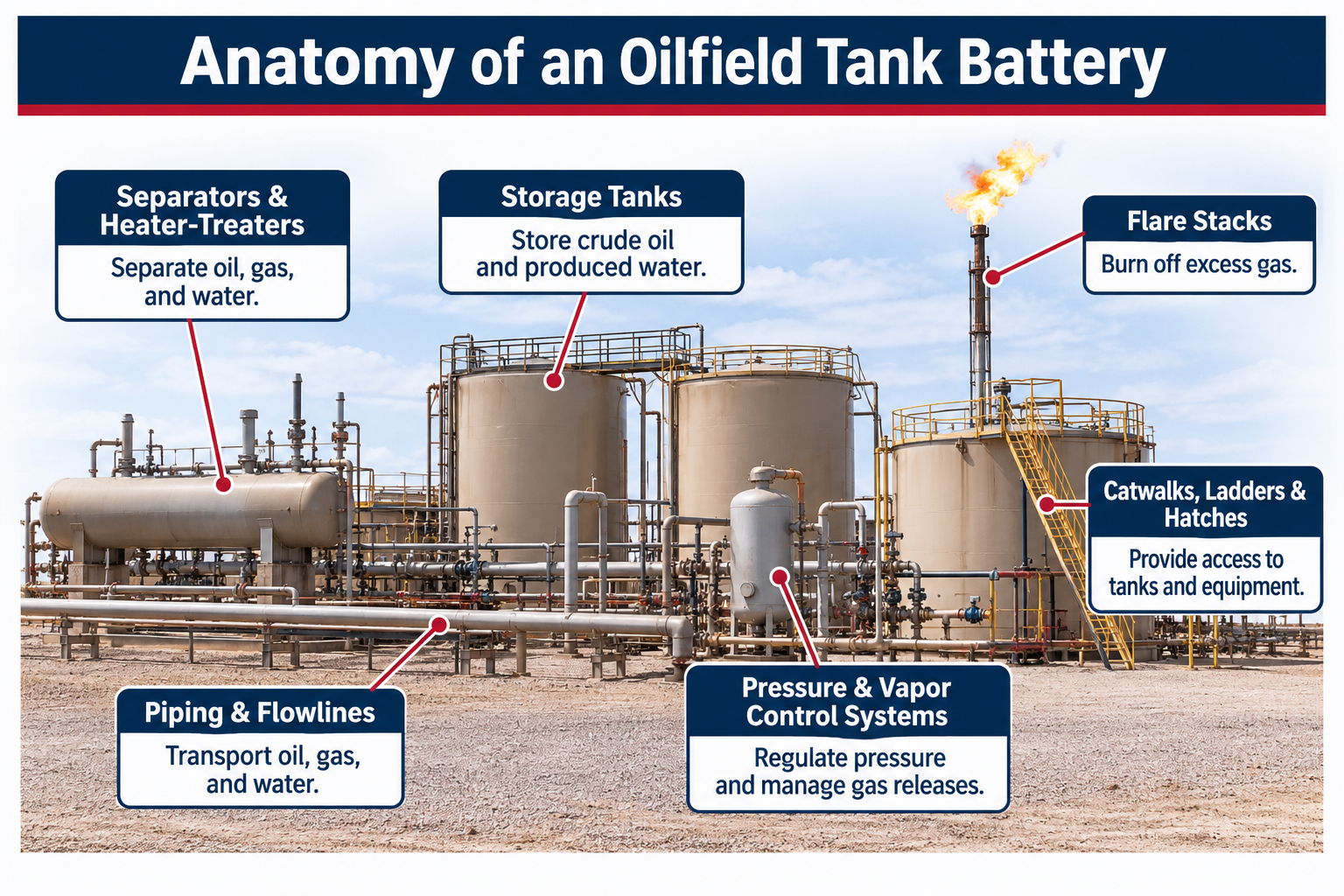
Tank batteries play a critical role in oilfield production throughout the Permian Basin. These interconnected systems separate, process, and store fluids extracted from oil and gas wells, including crude oil, natural gas, and produced water.
Although essential to oilfield operations, tank batteries can create serious safety hazards when improperly designed, installed, operated, or maintained. Flammable vapors, pressurized equipment, toxic gases, and potential ignition sources can put workers at risk of catastrophic injuries.
When critical safety systems fail or companies neglect known hazards, routine oilfield operations can quickly turn deadly.
Flare Flashbacks & Explosions
Tank batteries use flare systems to safely burn off excess natural gas and other combustible gases. However, changes in operating conditions, particularly low gas flow during startup, shutdowns, equipment modifications, or reduced production can destabilize a flare flame, allowing fire to travel backward through vent piping in a phenomenon known as flashback. The flame can ignite accumulated hydrocarbons inside tanks or connected equipment, triggering an explosion.
The resulting blast can rupture tanks, damage surrounding equipment, and ignite additional fires. Workers can suffer severe burns, and other catastrophic injuries from intense heat, flying debris, and collapsing equipment.
Combustible Vapor Accumulation
As crude oil and other petroleum products are stored and processed, they release flammable hydrocarbon vapors that can accumulate inside tanks or escape into the surrounding atmosphere. When these vapors mix with air in the right concentrations, even a small ignition source can trigger a flash fire or explosion.
A tank does not have to be full of oil to present an explosion hazard. Flammable vapors can remain inside tanks and connected equipment even after liquid contents have been removed, making temporary shutdowns, retrofitting, and low production phases during construction and operations especially hazardous.
Tank Battery Equipment & Safety Failures
Some of the most common equipment failures and safety violations that contribute to tank battery explosions and catastrophic oilfield accidents include:
- Equipment Failures and Defects: Defective or poorly maintained tanks, valves, pressure-relief systems, and venting equipment can allow pressure to build or hazardous gases to escape. Corrosion and deteriorating connections can also cause dangerous leaks.
- Inadequate Maintenance and Inspections: Failure to inspect, repair, or replace damaged equipment can lead to leaks, overpressure conditions, overfills, and other dangerous failures.
- Improper Venting and Vapor Management: Inadequate ventilation or improperly designed venting systems can allow flammable hydrocarbon vapors to accumulate inside tanks or around tank batteries.
- Ignition Sources: Welding, cutting, hot work, faulty electrical equipment, static electricity, and other ignition sources can ignite accumulated flammable vapors when proper precautions are not taken.
- Inadequate Hazard Monitoring: Failure to install, maintain, or properly use gas detection equipment can prevent workers from identifying dangerous vapor concentrations or other hazardous conditions before an accident occurs.
- Inadequate Worker Training and Safety Procedures: Workers must understand the hazards associated with tank batteries and follow appropriate procedures for gauging tanks, performing maintenance, and working around flammable gases.
- Hydrogen Sulfide (H2S) Exposure: Oilfield operations can release hydrogen sulfide, a highly toxic and flammable gas. Without proper monitoring, ventilation, respiratory protection, and emergency procedures, workers can suffer serious or fatal exposure.
Tank battery explosions rarely involve just one isolated failure. Instead, they can occur when multiple safety barriers break down at the same time. In our experience, the most serious oilfield accidents happen when companies disregard the protections designed to keep workers safe.
When operators fail to control hazardous conditions, maintain critical equipment, or enforce essential safety procedures, the consequences are often devastating. Workers may be left with severe, life-altering injuries. Families may also lose a loved one in an entirely preventable explosion.
Companies must be held accountable when their safety failures put workers’ lives at risk.
What Safety Regulations Apply to Oilfield Tank Batteries?
Oilfield tank batteries are subject to federal and state workplace safety, environmental, and operational requirements. Depending on the equipment and operation, applicable regulations and industry standards may include:
- OSHA Safety Standards: Workplace safety requirements governing hazardous materials, flammable gases, worker training, protective equipment, and fire prevention. OSHA has also issued a targeted flare flashback hazard alert with specific safety guidance on preventing oilfield tank battery explosions.
- EPA Spill Prevention and Emissions Rules: The Spill Prevention, Control, and Countermeasure (SPCC) Rule establishes spill prevention and secondary containment requirements for qualifying facilities. Clean Air Act requirements regulate emissions from certain oilfield storage tanks and production equipment.
- State Oil and Gas Regulations: In Texas, the Railroad Commission of Texas (RRC) regulates oil and gas operations, while the Texas Commission on Environmental Quality (TCEQ) oversees applicable environmental and air quality requirements. In New Mexico, the Oil Conservation Division (OCD) regulates tank battery operations, firewalls, spill prevention, and remediation.
- Industry Standards and Recommended Practices: The American Petroleum Institute (API), National Fire Protection Association (NFPA), and Center for Chemical Process Safety (CCPS) publish standards and guidance addressing tank design, venting, pressure controls, fire prevention, equipment inspections, and process safety. Although these standards are not automatically legally binding, they may become enforceable when incorporated into regulations or permits and provide important benchmarks for evaluating whether an oilfield company followed recognized safety practices.
Companies must identify and comply with all applicable safety regulations and implement appropriate safeguards to protect workers from preventable fires, explosions, and other hazards. When they fail to do so, they may face regulatory penalties, facility shutdowns, and, in certain circumstances, criminal liability. And when those same safety failures cause an accident that injures someone, the responsible parties must be held accountable.
What Evidence Is Important in an Oilfield Tank Battery Lawsuit?
Once hired, our attorneys and investigators immediately work to preserve critical evidence and determine what caused the explosion. Having successfully represented more than 1,000 oilfield accident victims across Texas, Louisiana, New Mexico, and the United States, we know what evidence to look for, how to establish who was responsible, and how to build a strong case for maximum compensation.
- Physical Evidence: Damaged tanks, piping, flare systems, pressure-relief equipment, and other failed components.
- Maintenance and Inspection Records: Documentation of equipment defects, repairs, safety inspections, and unresolved maintenance issues.
- Operating and Monitoring Data: Pressure and flow readings, gas detection records, alarm histories, and equipment operating logs.
- Safety Procedures and Training Records: Worker training materials, hazard assessments, job safety analyses, and hot work permits.
- Company and Incident Records: Internal communications, previous safety complaints, incident reports, and OSHA investigation findings.
Time and again, our investigations uncover evidence that companies failed to follow established safety protocols, ignored equipment problems, or neglected known hazards. We expose these failures, identify every responsible party, and fight to hold negligent companies accountable for the devastating consequences of their actions.
FAQs
What should I do after a tank battery accident?
Stop working immediately. If you’re physically able to, report your injury as soon as possible. Seek immediate medical treatment, and contact an Undefeated Oilfield Accident Lawyers as soon as possible to protect your legal rights — never give a formal statement, sign ANY paperwork, or accept any money from the company before speaking to a trusted attorney.
Who is responsible for a tank battery accident on the oilfield?
Depending on the circumstances, responsible parties may include oilfield operators, well owners, contractors, equipment manufacturers, and maintenance companies. An investigation can uncover which parties failed to follow safety protocols or prevent known hazards.
How long do I have to file a claim after a tank battery fire or explosion?
In Texas, the statute of limitations for most personal injury lawsuits is two years from the date of the accident. Different deadlines may apply depending on the responsible parties and circumstances, so it’s important to speak with an attorney as soon as possible.
Do I need an Oilfield Accident Lawyer?
Tank battery accidents often involve multiple contributing factors and responsible parties, who move quickly to avoid responsibility and pay victims as little as possible for their injuries and losses. Having an experienced oilfield accident lawyer on your side is critical — a team that knows how to investigate these complex accidents, identify the failures that caused them, and fight for the maximum compensation you and your family deserve.
Why Choose Zehl & Associates After an Oilfield Accident
The oilfield lawyer you choose can mean the difference between recovering maximum compensation or settling for far less than you deserve. At Zehl & Associates, we understand the oil and gas industry. We prepare every case for trial from day one. And we’ve never lost against major oil and gas corporations.
Our expertise, along with our experience and success in the courtroom, allows us to maximize our client’s recovery in each and every case we’re involved with.
Here’s why clients choose us:
- Record-breaking Results: We secured the Largest Oilfield Accident Settlement in U.S. History, including a $90 Million Oilfield Explosion Settlement and a $62 Million Oilfield Blowout Settlement for West Texas oilfield workers.
- Recognized Trial Attorneys: Ryan Zehl and Eric J. Allen were named among the 2027 Lawdragon 500 Leading Litigators in America for their work representing injured oilfield workers and families.
- Undefeated at Trial: We’ve never lost against the biggest oil and gas corporations in the world, and we cannot be outworked, outmaneuvered, or intimidated.
- Refusal to Settle for Less: If an offer doesn’t fully compensate you for all of your injuries and losses, we will take the case to trial — and win.
- Unwavering Commitment to Clients: We make sure our clients see the best doctors and medical providers in the country and stand by families every step of the way.
As our results demonstrate, we don’t just win for injured oil and gas workers and their families — we set records.
Undefeated Texas Oilfield Explosion Lawyers: 1-888-603-3636 for a Free Consult
With Billions won, including record-breaking verdicts and settlements for thousands of clients against the largest oilfield operators in the world, our Oilfield Explosion Lawyers have the resources, skills, and experience to ensure explosion victims and their families are fully compensated for all of their injuries and losses.
If you have questions about your legal rights and options following the Jones County oilfield explosion, please call 1-888-603-3636 or send us a confidential email via our Contact Us form.
During your consultation, our attorneys will answer your questions, go over your rights, and make sure you have the information to make the best decision for yourself and your family.
The consultation is completely free, and because we only take clients on a contingency-fee basis, you’ll pay nothing unless we win your case.