
Undefeated Houston Car Accident Attorneys
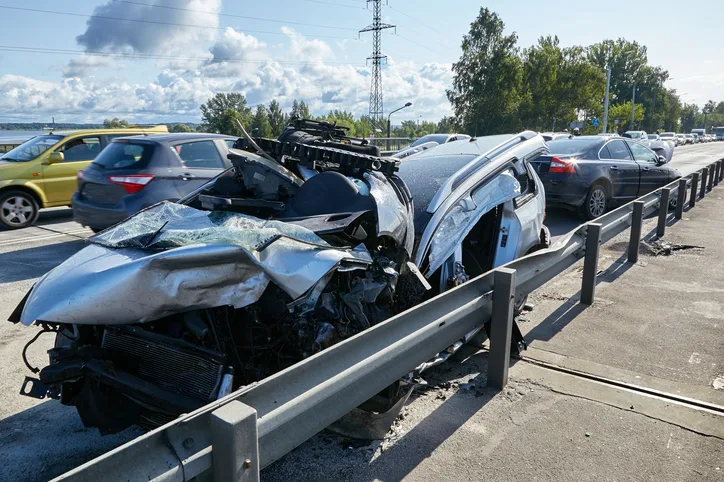
If you’re like most people, you probably think of a car accident as a straightforward, two-party incident: one driver did something wrong, the occupant of the other vehicle got hurt, and the at-fault driver pays. But not every crash is quite that simple. A multivehicle pileup on a major highway might involve one driver who stopped short, another who was following too closely, and a trucker who changed lanes without looking. A T-bone collision at an intersection can involve a driver who ran a light and another who was already speeding through on a yellow.
When more than one driver shares the blame, the question of who pays — and how much — is more complicated than most accident victims expect. Handled incorrectly, an injured driver can end up shouldering more than their fair share of the fault, slashing their financial recovery or wiping it out entirely.
Our Undefeated Houston Car Accident Lawyers have built our reputation by delivering for clients in even the most complex crash cases. When you hire our firm, we’ll leverage all of our resources and experience to build a strong case on your behalf—identifying every responsible party, fighting back against every attempt to inflate your share of the blame, and pursuing the maximum compensation possible for your injuries and losses.
Texas’s Answer: Everyone Pays Their Share
Texas follows a legal doctrine called comparative fault — each person who contributed to causing a car accident is financially responsible in proportion to their degree of blame. When evaluating a case, a judge or jury — or an insurance company during the claims process — assigns each driver a percentage of fault based on what they did and how their actions contributed to the collision. Each at-fault driver then pays that same percentage of the victim’s total damages.
Say two drivers hit you at an intersection. Driver A blew through a red light and is found 60% at fault. Driver B was speeding and couldn’t stop in time; Driver B is found 40% at fault. Your damages total $200,000.
- Driver A owes you $120,000
- Driver B owes you $80,000
Each one is on the hook for the role they actually played. Neither can avoid responsibility just because someone else was also negligent.
Comparative fault applies to you as well. If you contributed to the crash — say you were going 10 miles over the speed limit when another driver ran a stop sign and hit you — your compensation gets reduced by your own percentage of fault. For example, if a jury finds your total damages are $100,000, but you were 20% responsible, you recover $80,000. If you’re found 30% responsible, you recover $70,000. The math is straightforward.
But what happens when your percentage of fault keeps climbing? At a certain point, it doesn’t just reduce what you recover. It eliminates it entirely.
The 51% Rule in Texas Car Accidents
While you can recover compensation after a Texas crash even if you were partly at fault, your share of blame can be no more than 50%. If it’s determined that you’re 51% or more responsible, you recover nothing. Not a reduced amount. Zero.
- A driver found 50% at fault for a $200,000 accident still recovers $100,000
- A driver found 51% at fault for that same accident recovers nothing, even if the other driver was also negligent and caused serious harm
Just a single percentage point can break your case. That’s why insurers fight so hard to deflect blame away from their own policyholders. Every point they can shift onto you reduces what they owe. Get your number past 50%, and they owe you nothing.
Joint and Several Liability in a Texas Car Crash
Under Texas law, if any single driver is found 51% or more responsible for the crash, they can be liable for all of a victim’s damages — not just their proportional share. This is called joint and several liability.
Suppose Driver A is found 60% at fault and Driver B is found 40% at fault for your $100,000 in damages. Driver A owes $60,000, and Driver B owes $40,000. But what if Driver B has no insurance, or a policy that tops out at $10,000? Without joint and several liability, you’d be left eating most of that $40,000 yourself.
Because Driver A was found more than 50% at fault, you can go after the full $100,000 from Driver A alone. What Driver A owes to Driver B becomes their problem to sort out — not yours. That’s a fight between two defendants, not a loss borne by the person who did nothing wrong.
Fault Doesn’t Always End With the Drivers
Negligent drivers aren’t always the only parties responsible for a serious car accident. Depending on the circumstances of the wreck, other parties may share the blame. In that scenario, injured victims have the right to pursue legal action against those third parties, such as:
- Employers: If one of the at-fault drivers was working at the time of the crash — making a delivery, driving a company vehicle, running a work errand — their employer can be held responsible for their negligence.
- Vehicle and Parts Manufacturers: If a mechanical failure contributed to the crash — defective brakes, a faulty steering component, a tire with a manufacturing defect, a safety system that didn’t deploy the way it was supposed to — the company that made the vehicle or the defective part may bear some of the fault.
- Bars and Restaurants: Under Texas’s dram shop law, a bar, restaurant, or other alcohol-serving establishment can be held liable if it served alcohol to a visibly intoxicated person who then got behind the wheel and caused a crash.
- Cargo Loaders: If a commercial truck or 18-wheeler was involved in the crash and improperly loaded or secured cargo contributed to the accident — whether by shifting and causing the driver to lose control, or by falling off the vehicle and creating a hazard — the company responsible for loading that cargo may share the blame.
- Vehicle Owners: If the at-fault driver didn’t own the vehicle they were driving, the owner could be liable for the crash. We typically see this in accidents involving commercial vehicles, where a trucking company or another entity leases the vehicles in its fleet.
- Government Entities: If a poorly designed intersection, a missing or obscured traffic sign, a malfunctioning signal, or other dangerous road condition played a role in the accident, the government agency responsible for maintaining that road may share responsibility. However, in Texas, these claims are subject to strict notice requirements and shorter filing deadlines than standard personal injury cases, so it’s even more important that you hire an attorney as quickly as possible.
How Fault is Proven After a Crash
Whether fault is assigned by an insurance adjuster, a judge, or a jury, the determination is based on the evidence, including:
- The police report and the responding officer’s on-scene observations
- Witness statements from anyone who saw what happened
- Traffic and surveillance camera footage
- Cell phone records showing whether a driver was texting or on a call at the moment of impact
- Black box data from the vehicles, recording speed, braking, and steering inputs in the seconds before the crash
- Accident reconstruction experts who can work backward from the physical evidence to establish exactly how the collision unfolded
- Physical evidence — skid marks, debris fields, and the damage patterns on each vehicle
In most cases, the initial fault determination is made during the insurance claims process. Each driver’s insurer conducts its own investigation and reaches its own conclusions. When they can’t agree, the case may have to go to trial.
However, fault determination is not a precise science. Two adjusters looking at the same crash can reach very different conclusions. Two juries hearing the same evidence can return very different verdicts. The percentages are shaped by evidence, advocacy, and argument — which is why the quality of both the investigation and your legal representation can have an enormous impact on the amount of compensation you might ultimately recover.
What to Expect from the Insurance Companies
After any Texas car crash, every insurance company involved has one goal: minimize its payout to the greatest extent possible. More often than not, they’ll attempt to do that by exploiting comparative fault.
Blaming You
Insurance adjusters are trained to look for any evidence of your own negligence. Were you speeding? Distracted? Did you fail to brake in time? Were you wearing a seatbelt? Every percentage point of fault they can assign to you reduces their payout. If they can push your share past 50%, they owe you nothing at all.
Pointing Fingers at Each Other
In cases involving multiple at-fault drivers, their insurers often spend as much energy blaming each other as they spend investigating the crash. Each insurer wants to increase the other’s fault percentage and decrease its own client’s. The result can be a lengthy dispute between insurance companies that leaves you in the middle — waiting, frustrated, and watching your bills pile up while the insurers argue over percentages.
Settling Fast and for Too Little
When multiple defendants share fault, each insurer will move quickly to settle their client’s portion of the claim — before the full extent of your injuries is known, before all responsible parties have been identified, and before you’ve spoken to an attorney. Once you sign a release with one defendant, you generally can’t go back. Settling too early with the wrong party can complicate or eliminate your claims against the others, leaving you with a fraction of what your case was actually worth.
What to Do After a Texas Car Accident
Insurance companies are not on your side. They have teams of adjusters, investigators, and attorneys whose job is to pay you as little as possible — and in a crash involving multiple drivers and other at-fault parties, every one of them is working against you. So what should you do to counter their tactics and ensure you’re paid every dollar of compensation you deserve?
- Call 911: The police will come to the scene and gather information for an official report that will be important if you choose to pursue legal action against the at fault-drivers. EMTs will also arrive to aid anyone who is injured.
- Take pictures of everything you can: If you are able to do so, photograph your injuries, the damage to all vehicles involved, their positions, skid marks, traffic signals, and anything else that could help prove what caused the crash and the extent of your damages.
- Get the names and addresses of every witness: Their accounts can prove pivotal when more than one party is at fault, and everyone is pointing fingers at everyone else.
- Go to the emergency room, even if you feel fine: Many serious injuries — including traumatic brain injuries, internal bleeding, and soft tissue damage — don’t show up immediately. A gap in medical treatment is one of the first things insurance companies use to question the extent of your injuries.
- Report the accident to your insurance company as soon as possible: But do not give a recorded statement to any insurance company, including your own, until you’ve spoken with an experienced car accident attorney. What you say in those early conversations can and will be used against you.
- Don’t speculate about fault with anyone: Not at the scene, not with the other drivers, not with insurance adjusters. Even seemingly innocuous states could be used to blame you for the crash.
- Keep a record of every expense related to your injuries and property damage: lost wages, medical bills, prescriptions, doctor’s visits, rental cars, and anything else that costs you money as a result of the crash. Save every receipt and document everything in writing.
- Keep a record of every conversation you have with any insurance company: Write down the date, the name, phone number, and job title of the person you spoke with, and what was said. These details matter when disputes arise later.
- Do not sign anything or accept any settlement offer: Early settlement offers are rarely in your best interest, and signing a release with one defendant can compromise your claims against the others. Speak with an attorney before you agree to anything.
- Assume you’re being monitored: Insurance companies routinely surveil accident victims, and anything that contradicts your claimed injuries will be used against you. They’ll even monitor your social media activity.
- Limit all discussion of the accident and your injuries to your spouse and your attorney: Everyone else — friends, coworkers, neighbors, social media followers — is a potential source of damaging information for the other side.
- Hire an experienced Texas car accident lawyer right away: According to a study conducted by the Insurance Research Council, car accident victims represented by a personal injury lawyer recovered 3.5 times more in settlement compensation than those who did not hire a lawyer.
How Our Undefeated Car Accident Lawyers Can Help
When you hire our Undefeated Texas Car Accident Lawyers, you’re choosing a team of experienced trial attorneys who begin preparing every case as if it’s going to trial from day one. That level of preparation — backed by the full resources of our firm — enables us to consistently recover record-setting verdicts and settlements on behalf of our clients.
- We work with the best experts in the country — medical specialists, accident reconstructionists, engineers, life-care planners, economists, and investigators — to determine exactly how the crash happened, the full extent of your injuries, and what you’ll need now and in the future.
- We understand how insurance companies avoid paying victims what they’re owed — and we know how to shut down their attempts to shift blame, minimize injuries, deny treatment, and dispute fault.
- We know what evidence is needed to prove your claim — and how to secure it before it can be lost or destroyed — including black box data, surveillance footage, phone records, vehicle maintenance logs, and employment files.
- We never even consider inadequate settlement offers. While we seek to settle our cases out of court, we’ll never accept any offer that doesn’t fully compensate our clients for ALL of their injuries and losses. All of our trial lawyers remain undefeated in court. Insurance companies know our record, and they often raise their offers once they realize we are fully prepared to go to trial.
Undefeated Houston Car Accident Lawyers with Billions Won: Call (888) 603-3636 or Click Here for a Free Consult
In addition to winning Billions for our clients, our Undefeated Houston Car Accident Lawyers consistently recover the largest verdicts and settlements in Texas and in our opponents’ corporate history.
If you or someone you love was hurt in a Texas car crash, call (888) 603-3636, use our “chat” button, or send us a confidential email through our “Contact Us” form.
All consultations are free, and you won’t owe us a penny unless we win your case.