
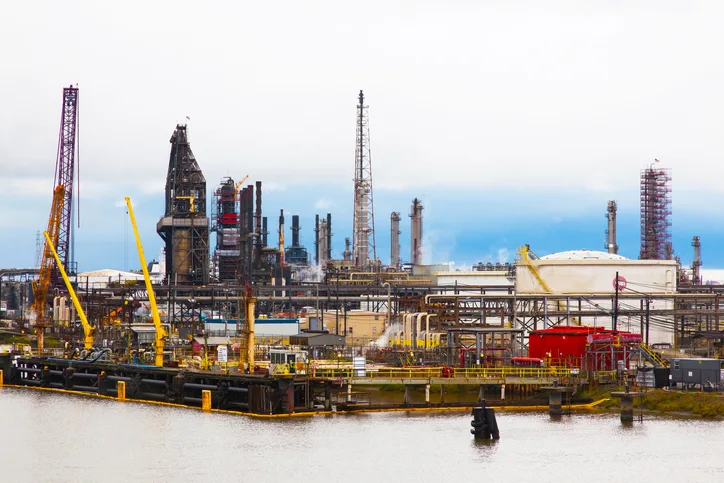
Since the first oil gusher blew at Spindletop in 1901, the refineries, chemical plants, and petrochemical facilities scattered across Texas have made the Lone Star State the energy engine of a nation that runs on oil and gas.
But having won billions for thousands of clients in connection with some of the worst industrial accidents in Texas history, our Undefeated Plant Explosions Lawyers understand all too well the heavy price Texans have paid for that dominance—workers killed and catastrophically injured, communities poisoned, and even small towns virtually erased from the map.
In every case, the worst industrial accidents in Texas were anything but accidental. Rather, they were entirely preventable and occurred only because a company chose to prioritize profits over the health and well-being of its employees and those living and working in surrounding communities.
The Texas City Ammonium Nitrate Explosion
On the morning of April 16, 1947, a crowd of curious bystanders gathered on the docks of Texas City to watch the SS Grandcamp burn. Firefighters had it in hand, or so everyone thought. Then, at 9:12 a.m., the ship simply ceased to exist — replaced by a fireball that blew two sightseeing planes out of the sky, generated a 15-foot tsunami, and registered on a seismograph in Denver.
What triggered the disaster that remains ot this day the worst in Texas history? A fire had erupted in the ship’s cargo hold, which contained some 2,300 tons of highly volatile ammonium nitrate fertilizer bound for famine-stricken Europe. The captain, hoping to spare the cargo, chose not to flood the hold with water and instead sealed the hatches and pumped steam into the vessel. But rather than stave off disaster, the SS Grandcamp became a dangerous pressure cooker that eventually exploded, leveling nearly 1,000 buildings in the surrounding community. Sixteen hours later, the flames from the initial explosion reached another ship filled with fertilizer, triggering a second deadly blast.
By the time it was over, all but one of Texas City’s 28 volunteer firefighters had been killed, along with 234 workers at a Monsanto plant located a full 300 feet from the blast site. More than 5,000 people were injured, and over 500 homes were destroyed.
The Phillips 66 Disaster
On October 23, 1989, a maintenance crew at the Phillips 66 Houston Chemical Complex was clearing a blockage in a polyethylene reactor — a routine job done dozens of times before — when improperly installed safety valves allowed approximately 85,000 pounds of highly flammable process gases to escape from the reactor. Just 90 seconds later, the resulting vapor cloud found an ignition source, setting off a series of explosions that registered 3.5 on the Richter scale and produced a fireball visible 15 miles away.
Buildings shook in downtown Houston. Homes were damaged eight miles from the blast site, and two production plants were destroyed. But the property damage paled in comparison to the human toll: 23 workers killed, 314 others injured.
While federal regulators had cited the Phillips 66 Complex for numerous safety violations in the past, the subsequent investigation revealed that the plant had not undergone a comprehensive inspection for well over a decade.
“OSHA’s findings in the investigation of the Phillips complex disaster,” the agency wrote in its April 1990 Report to the President, “support the conclusion that poor risk assessment and management, lack of redundant systems and fail-safe engineering, inadequate maintenance of equipment, poorly conceived operational or maintenance procedures, and incomplete employee training are the underlying factors that contribute to or heighten the consequences of an accident.”
The ARCO Chemical Explosion
Eight months after the Phillips 66 disaster, the Houston Ship Channel was rocked yet again when another explosion tore through a wastewater treatment unit at the ARCO Chemical Company complex, instantly killing all 17 workers in the vicinity.
The treatment tank, which normally contained 900,000 gallons of wastewater and chemicals, had been taken out of service for routine maintenance of a compressor and other nearby equipment. As a result, normal flow of nitrogen purge gas to the tank was minimal, allowing peroxides to decompose and create dangerous levels of oxygen. Tragically, a malfunctioning gauge had registered an incorrect reading, leaving the maintenance crew unaware of the imminent danger. Once the compressor was restarted, the oxygen vapors ignited, causing the explosion.
OSHA subsequently cited the company for 347 “willful” safety violations, including failure to monitor the buildup of an explosive atmosphere, failure to control ignition sources, allowing the accumulation of excessive hydrocarbons, inadequately controlling human error, failure to provide workers with adequate hazardous-waste training, and failure to administer emergency response plans adequately.
While it disputed the agency’s findings, ARCO agreed to pay a $3.48 million fine, the largest OSHA had ever collected up to that point. The company also agreed to establish worker safety programs at the four plants it operated across the country.
The BP Texas City Refinery Explosion
More than 25 years ago, BP’s Texas City refinery was the third-largest in the United States, processing 433,000 barrels of crude oil every day. It was also, according to its own internal audits — which BP kept quiet — a facility in serious decay.
On the morning of March 23, 2005, the refinery was just coming back online after a routine maintenance shutdown. As contractors moved between units and equipment began cycling up, nothing had occurred that morning to suggest the day would end in catastrophe. But shortly after 1 p.m., the first of a series of powerful explosions tore through the facility. Fifteen contract workers died instantly, and 180 were injured, many with severe burns.
The subsequent investigation blamed the tragedy on a massive overflow of flammable hydrocarbons during the startup of an isomerization unit. Operators accidentally overfilled a distillation tower due to faulty sensors and malfunctioning alarms. Meanwhile, a culture of cost-cutting had left the refinery with an outdated vent system rather than a safer flare. The resulting geyser of liquid and vapor ignited upon contact with a nearby idling truck, triggering the first explosion. All of those killed were stationed in trailers that BP had placed too close to the hazardous equipment.
BP would ultimately pay more than $2.1 billion to settle civil lawsuits, along with $84.6 million in OSHA fines, $27 million to the EPA, and a $50 million fine to the state of Texas — then the largest regulatory settlement in the history of the American refining industry.
The West Fertilizer Company Explosion
The West Fertilizer Company had been a fixture in the small town of West, Texas, since 1962. In a safety plan filed with the EPA in 2011, the company stated with extraordinary confidence that there was no risk of explosion — even as the facility stored 270 tons of ammonium nitrate in the middle of a residential neighborhood, next to a nursing home and across the street from a school.
Less than two years later, on April 17, 2013, a fire broke out in the plant’s seed room. The flames quickly spread to a nearby storage bin containing ammonium nitrate, triggering a powerful explosion that killed 15 people—12 of them firefighters responding to the initial fire—and left 160 injured. The catastrophe practically leveled the community. Scores of buildings were demolished, including the nursing home and three of the town’s four schools. At least 500 nearby homes were either destroyed or damaged as a result of the blast.
The U.S. Chemical Safety Board later concluded that the fire and explosion could have been prevented, placing the blame on federal, state and local regulatory agencies for “failing to identify a serious hazard and correct it.” OSHA cited the West Fertilizer Company for 24 serious safety violations, including unsafe handling and storage of anhydrous ammonia and ammonium nitrate. Yet despite these significant failures, the West Texas Fertilizer Company paid just $118,300 in fines.
The Arkema Chemical Plant Fire
When Hurricane Harvey made landfall in August 2017, most attention was fixed on the catastrophic flooding overwhelming Houston. But 30 miles northeast in Crosby, Texas, a separate disaster was unfolding largely unnoticed.
The Arkema chemical plant produced organic liquid peroxides used in plastics. During the storm, the facility was inundated with more than 40 inches of floodwaters, knocking out power to its critical refrigeration system. As the organic peroxides began to overheat, Arkema management knew exactly what was coming. They evacuated the facility and warned local authorities that a fire was inevitable. They were right. The chemicals self-ignited on August 29th, triggering a fire that was quickly followed by two explosions. Arkema was ultimately forced to burn nine trailers filled with organic peroxides to prevent an even greater catastrophe.
Unfortunately, plant management had failed to notify first responders about the chemicals they would encounter. A dozen sheriff’s deputies were subsequently hospitalized after being overcome by toxic fumes at the scene, while more than 20 people sought medical attention after the vapor traveled across a public highway adjacent to the plant. Over 200 residents living within 1.5 miles of the facility were forced to evacuate their homes; they would not be able to return for more than a week.
The TPC Group Explosion
Just one day before Thanksgiving 2019, residents of Port Neches, Texas, were jolted from their sleep when the TPC Group Plant erupted in a massive fireball that lit up the skies across southeast Texas. In addition to injuring three plant employees, the blast caused widespread damage throughout the surrounding community and forced the residents of Port Neches, Groves, Nederland, Central Gardens, Beauxart Gardens, and parts of Port Arthur to evacuate through Thanksgiving Day.
Secondary explosions continued for days. When the evacuation order was finally lifted, many residents returned to find cracked foundations, blown-out windows, and extensive structural damage to their homes. Asbeston-tainted debris littered their yards.
According to the CSB, the sequence of events leading up to the TPC explosion began when 60,000 gallons of liquid vapor – mostly highly flammable butadiene – escaped from a processing tower. The vapor ignited about two minutes later, sparking the days-long fire that destroyed much of the facility. According to the CSB final report, TPC was aware of safety deficiencies prior to the explosion but failed to address them.
OSHA subsequently cited the TPC Group for a dozen safety violations, including three deemed “willful:” failing to provide updated instructions on how to shut down affected equipment, neglecting to fix deficient equipment that could have caused the explosion or alerted workers to a problem, and failing to follow proper procedures on a pipeline known to cause issues with butadiene. The TPC Group was fined a total of $514,692, including the maximum penalty of $134,937 for each of the three willful violations.
ITC Deer Park Fire
On the morning of St. Patrick’s Day 2019, a circulation pump on a storage tank at the Intercontinental Terminals Company facility in Deer Park, Texas, malfunctioned. For roughly 30 minutes, butane-enriched naphtha leaked undetected before its vapors ignited — touching off a fire that would burn for three days and sending a towering black plume of smoke across the Houston skyline.
The blaze rapidly spread to 14 of the 240 tanks located on the site. When a containment wall breached, nearly half a million barrels of toxic chemicals — including benzene and xylene — poured into Tucker Bayou and the Houston Ship Channel, forcing the closure of a seven-mile stretch of the waterway. Shelter-in-place orders were issued for the entire city of Deer Park, closing schools and businesses.
Nearly 1,000 people sought treatment at a single pop-up clinic in the disaster zone, reporting headaches, nosebleeds, vomiting, and burning eyes and throats. Fifteen patients were transferred to hospitals with serious respiratory problems. Benzene levels in the air remained dangerously elevated for weeks after the fire was extinguished.
The CSB’s final report, released four years later, concluded that the disaster was entirely preventable. As far back as 2014, a hazard review team had recommended installing flammable gas detection systems near the tank where the fire began. ITC never acted on that recommendation — and never documented why
The KMCO Chemical Plant Explosion
Just after dawn on April 2, 2019, residents of Crosby, Texas, were jolted awake by a massive explosion. A release of isobutylene gas had made contact with an ignition source at the nearby KMCO chemical plant, triggering a deadly blast that lit up the morning sky.
Killed that morning was a 27-year-old man from Daisetta who had spotted the leak, donned protective gear, and walked out of the safety of an explosion-proof control room to help his colleagues. His body was found later that day near one of the plant’s gates, his air tank still strapped to his waist. Twenty others suffered serious burns and were airlifted to trauma centers in Houston. As crews worked to bring the resulting fire under control, a toxic plume began drifting toward surrounding neighborhoods, triggering shelter-in-place orders across the area.
According to the CSB’s subsequent investigation, KMCO’s hazard evaluations had repeatedly overlooked the fact that a critical piece of equipment — the y-strainer at the heart of the isobutylene system — was made of cast iron, a brittle material that, according to industry standards, should not be used in hazardous applications. Because the plant lacked remote isolation equipment, workers could not safely stop the leak. And when they tried to respond, they did so without clear guidance on what actions were safe to take and what weren’t — a failure of training and emergency procedures that may have cost the deceased worker his life.
Tragically, the KMCO explosion was entirely predictable. The company had been criminally convicted of Clean Air Act violations in 2016 and ordered to pay $3.3 million in fines — yet the citations kept coming. In the decade before the explosion, KMCO had accumulated more than $4 million in federal fines for safety violations. Yet state regulators had collected just $150,000 from the company during the same period.
Undefeated Texas Plant Explosion Lawyers: Call 1-866-603-3636 or Click Here for a Free Consult
In addition to winning Billions for our clients, our undefeated Houston refinery explosion lawyers consistently recover record-breaking verdicts and settlements in connection with the worst industrial accidents in Texas,
- #1 Largest Individual Burn Settlement in U.S. History
- $75 Million Settlement for workers injured in refinery explosion
- $85 Million Settlement for injured refinery contractors
- $100 Million settlement on behalf of a group of workers, despite the company’s attempt to limit each to less than $50,000 in workers’ comp benefits.
- The #1 Largest Accident Verdict in Texas
- The #1 Largest Accident Settlement in Texas
If you or someone you love were hurt in an industrial accident or explosion, call (888) 603-3636 or fill out our confidential contact us form.
We’ll take the time to answer your questions, explain your rights, and provide the information you need to make the best decision for you and your family.
Your consultation is free and confidential, and you won’t pay us a dime unless we win your case.